Biomechanics: Concepts and Computation

Using a quantitative biomechanics approach, this book integrates both general and specific topics, theoretical background and biomedical engineering applications, as well as analytical and numerical approaches.
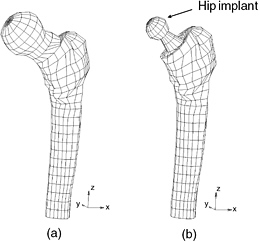
One of the first applications of the Finite Element Method in biomechanics has been the analysis of the mechanical behaviour of bone [2]. In particular the impact of prosthesis implants has been investigated extensively. An example of a finite element mesh used to analyse the mechanical stresses and strain in a human femur is given in Fig. 18.1(a). In Fig. 18.1(b) the femur head is replaced by a prosthesis. In this case the prosthesis has different mechanical properties compared to the bone, leading to high stress concentrations at some points in the bone and stress shielding (lower stresses than normal) in other parts. This normally leads to a remodelling process in the bone that has to be accounted for when new prostheses are designed. The purpose of this chapter is to introduce the finite element theory that forms the basis of these analyses.
Neglecting inertia, the momentum equation, Eq. (11.9), may be written as

where  denotes the gradient operator, ? the Cauchy stress tensor and
  a given distributed volume load. This equation should hold at each position within the domain of interest ?, having boundary ?, and must be supplemented with suitable boundary conditions. Either the displacement field
  is specified...

 TABLE OF CONTENTS