Biomechanics: Concepts and Computation

Using a quantitative biomechanics approach, this book integrates both general and specific topics, theoretical background and biomedical engineering applications, as well as analytical and numerical approaches.
In this chapter the concepts introduced in Chapter 6 for a one-dimensional continuous system are generalized to two-dimensional configurations. Extension to three-dimensional problems is briefly discussed. First the equilibrium conditions in a two- or three-dimensional body are derived from force equilibrium of an infinitesimally small volume element. Thereafter, the concept of a stress tensor, as a sum of dyads, is introduced to compute the stress vector acting on an arbitrary surface in a material point of the body.
Before examining the equilibrium conditions in a two-dimensional body, the concept of a stress vector is introduced. For this purpose we consider an infinitesimally small surface element having area ? A, see Fig. 8.1.
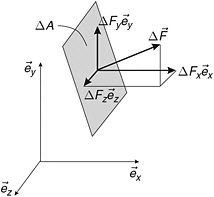
 on an infinitesimal surface element having area ?A.
On this surface an infinitesimally small force vector is applied with components in the x-, y- and z-direction:  . Following the definition of stress, Eq. (6.8), three stresses may be defined:
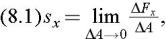
that acts in the x-direction, and
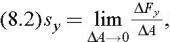
that acts in the y-direction, and
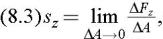
that acts in the z-direction. Hence, a stress vector may be defined:

Suppose, that a free body diagram is created by means of an imaginary cutting plane through a body. The cutting plane is chosen in such a way that it coincides with the xy-plane (Fig. 8.2). On the imaginary cutting plane a stress vector  is given as a function of x

 TABLE OF CONTENTS