Biotechnology Procedures and Experiments Handbook
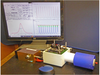
A spectrophotometer measures the relative amounts of light energy passed through a substance that is absorbed or transmitted. We will use this instrument to determine how much light of (a) certain wavelength(s) is absorbed by (or transmitted through) a solution. Transmittance (T) is the ratio of transmitted light to incident light. Absorbance (A)= ?log T. Absorbance is usually the most useful measure, because there is a linear relationship between absorbance and concentration of a substance. This relationship is shown by the Beer-Lambert law:
where
e=extinction coefficient (a proportionality constant that depends on the absorbing species)
b=pathlength of the cuvette. Most standard cuvettes have a 1-cm path and, thus, this can be ignored
c=concentration.
A spectrophotometer or calorimeter makes use of the transmission of light through a solution to determine the concentration of a solute within the solution. A spectrophotometer differs from a calorimeter in the manner in which light is separated into its component wavelengths. A spectrophotometer uses a prism to separate light and a calorimeter uses filters.
Both are based on a simple design, passing light of a known wavelength through a sample and measuring the amount of light energy that is transmitted. This is accomplished by placing a photocell on the other side of the sample. All molecules absorb radiant energy at one wavelength of another. Those that absorb energy from within the visible spectrum are known as pigments. Proteins and nucleic acids absorb light in the ultraviolet range. The following figure...