Biotechnology Procedures and Experiments Handbook

Microscope
Hemocytometer and coverslip
Suspension of yeast
Make a serial dilution series of the yeast suspension, from 1/10 to 1/1000.
Obtain a hemocytometer and place it on the desk before you. Place a clean coverslip over the center chamber.
Starting with the 1/10 dilution, use a Pasteur pipette to transfer a small aliquot of the dilution to the hemocytometer. Place the tip of the pipette into the V-shaped groove of the hemocytometer and allow the cell suspension to flow into the chamber of the hemocytometer by capillary action until the chamber is filled. Do not overfill the chamber.
Add a similar sample of diluted yeast to the opposite side of the chamber and allow the cells to settle for about 1 minute before counting.
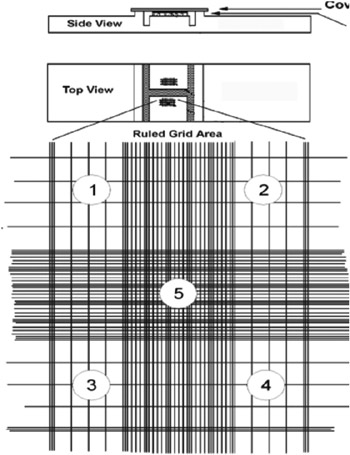
Refer to the diagram of the hemocytometer grid in Figure 12 and note the following.
Figure 12: Hemocytometer.
The coverslip is 0.1 mm above the grid, and the lines etched on the grid are at preset dimensions.
The 4 outer squares, marked 1 4, each cover a volume of 10 4 mL.
The inner square, marked as 5, also covers a volume of 10 4 mL, but is further subdivided into 25 smaller squares. The volume over each of the 25 smaller squares is 4.0 10 ?6 mL.
Each of the 25 smaller squares is further divided into 16 squares, which are the smallest gradations on the hemocytometer. The volume over these smallest squares...