CMOS Analog Circuit Design

In the previous chapter we introduced the analysis and design of general unbuffered CMOS op amps with an eye to developing the principles associated with the design of CMOS op amps. However, in many applications the performance of the unbuffered CMOS op amp is not sufficient. In this chapter, CMOS op amps with improved performance will be considered. These op amps should be capable of meeting the specifications of most designs.
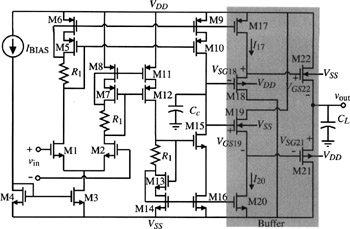
Typically, the areas where increased performance is desired include lower output resistance, larger output-signal swing, increased slew rate, increased gain bandwidth, lower noise, lower power dissipation, and/or lower input-offset voltage. Of course, not all of these characteristics will be obtained at the same time. In many cases, simply including the buffer of Fig. 7.1-1 will achieve the desired performance. We shall examine several types of buffers that can be used to increase the capabilities of the unbuffered CMOS op amp.
The first topic of this chapter deals with the reduction of the output resistance of the op amp in order to drive resistive loads. Such op amps are called buffered op amps. The first approach uses a MOSFET in the source-follower configuration to achieve lower output resistance. As we know, the lowest output resistance without using negative feedback is 1/ g m. The second approach uses negative feedback to achieve output resistances in the range of 10 ?. Unfortunately, there...