CMOS Analog Circuit Design

9.3: SWITCHED CRPACITOR INTEGRATORS

9.3 SWITCHED CRPACITOR INTEGRATORS

The switched capacitor integrator is a key building block in analog signal-processing circuits. All filter design can be reduced to noninverting and inverting integrators. In this section, we will first examine continuous time integrators to understand the desired performance of switched capacitor integrators. The remainder of the section will discuss switched capacitor integrators and illustrate their frequency response characteristics. The influence of the non-ideal characteristics of the op amp and switches on the performance will be presented. In Section 9.5 we will look at damped switched capacitor integrators or first-order, low-pass circuits.

Continuous Time Integrators

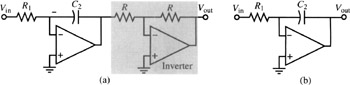
Noninverting and inverting continuous time integrators using op amps are shown in Fig. 9.3-1. While it is possible to find a noninverting integrator configuration using one op amp, Fig. 9.3-1(a) is used because it is one of the simplest forms of a noninverting integrator. We will characterize the integrators in this section in the frequency domain although we could equally well use the time domain. The ideal transfer function for the noninverting integrator of Fig. 9.3-1(a) is


Figure 9.3-1: (a) Noninverting and (b) inverting continuous time integrators.

where ? 1 is called the integrator frequency. ? 1 is equal to 1/ ? 1 and is called the integrator time constant. ? 1 is the frequency where the magnitude of the integrator gain is unity. For the inverting integrator, the ideal transfer function is


Figure 9.3-2 gives the ideal magnitude and phase response of the noninverting and...

UNLIMITED FREE
ACCESS
TO THE WORLD'S BEST IDEAS

SUBMIT
Already a GlobalSpec user? Log in.

This is embarrasing...

An error occurred while processing the form. Please try again in a few minutes.

Customize Your GlobalSpec Experience

Category: Active High Pass Filters
Finish!
Privacy Policy

This is embarrasing...

An error occurred while processing the form. Please try again in a few minutes.