CMOS Analog Circuit Design

9.2: SWITCHED CAPACITOR AMPLIFIERS

9.2 SWITCHED CAPACITOR AMPLIFIERS

In this section, the use of switched capacitors for amplification will be presented. This class of circuits will use the op amp with negative feedback to achieve gains that are proportional to the ratios of capacitors. We will begin with amplifiers using resistor feedback. These amplifiers will serve as the basis for switched capacitor amplifiers. The influence of the op amp open-loop gain and unity-gain bandwidth on these amplifiers will be examined.

Continuous Time Amplifiers

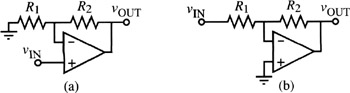
Figure 9.2-1 shows the familiar noninverting and inverting amplifiers using resistors and op amps. The ideal gain of both circuits can easily be found [ [6]]. For the noninverting amplifier of Fig. 9.2-1(a), the ideal gain is


and for the inverting amplifier of Fig. 9.2-1(b), the ideal gain is


The results of Eqs. (9.2-1) and (9.2-2) assume that the differential gains of the op amps in Fig. 9.2-1 approach infinity.


Figure 9.2-1: (a) Continuous time noninverting amplifier. (b) Continuous time inverting amplifier.

The influence of a finite gain and finite unity-gain bandwidth can be seen by replacing the op amps of Fig. 9.2-1 with a voltage-controlled, voltage source model shown in Fig. 9.2-2. The voltage gain, A vd( s), is a function of the complex frequency variable, s, and is given as


where A vd(0) is the low-frequency differential voltage gain, GB is the unity-gain bandwidth. and ? a is the ?3 dB frequency of the op amp. The influence of A

UNLIMITED FREE
ACCESS
TO THE WORLD'S BEST IDEAS

SUBMIT
Already a GlobalSpec user? Log in.

This is embarrasing...

An error occurred while processing the form. Please try again in a few minutes.

Customize Your GlobalSpec Experience

Category: Operational Transconductance Amplifiers (OTA)
Finish!
Privacy Policy

This is embarrasing...

An error occurred while processing the form. Please try again in a few minutes.