CMOS Analog Circuit Design

Appendix C: Time and Frequency Domain Relationships for Second-Order Systems

OVERVIEW

There are many reasons for considering the time and frequency domain relationships of a second-order system in the study of operational amplifiers. One is that many operational amplifier configurations can be modeled with reasonable accuracy assuming just a second-order system. Such a procedure represents a reasonable compromise between complexity and accuracy of the model. Another reason is that these relationships allow us to predict frequency domain performance from the simpler to measure time domain performance.

C.1 GENERAL SECOND-ORDER SYSTEM IN THE FREQUENCY DOMAIN

The general transfer function of a low-pass, second-order system in the frequency domain using voltage variables is


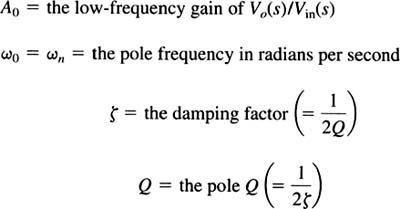
where


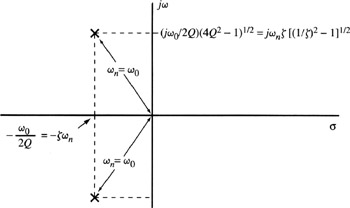
The roots of Eq. (C.1-1) are illustrated in Fig. C.1-1.


Figure C.1-1: Pole locations of a general second-order system.

The magnitude of the frequency response can be found from Eq. (C.1-1) as


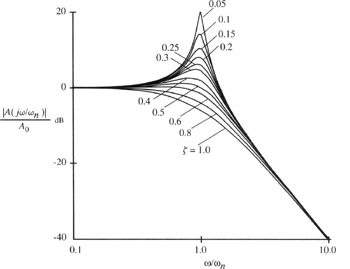
However, Eq. (C.1-2) may be generalized by normalizing the amplitude with respect to A 0 and the radian frequency by ? n to give


A plot of Eq. (C.1-3) in dB versus log ?/ ? n is shown in Fig. C.1-2, where ? or Q is used as a parameter. By taking the derivative of Eq. (C.1-3) with respect to ?/ ? n and setting it to zero, the peak of A(j ?/ ? 0)/A 0 can be found as


Figure C.1-2: Gain magnitude response for various values of for a second-order, low-pass system.

when ? < 0.707.

The second-order function of Eq. (C.1-1) is...

UNLIMITED FREE
ACCESS
TO THE WORLD'S BEST IDEAS

SUBMIT
Already a GlobalSpec user? Log in.

This is embarrasing...

An error occurred while processing the form. Please try again in a few minutes.

Customize Your GlobalSpec Experience

Category: IC Electronic Filters
Finish!
Privacy Policy

This is embarrasing...

An error occurred while processing the form. Please try again in a few minutes.