CMOS Analog Circuit Design

9.1: SWITCHED CAPACITOR CIRCUITS

9.1 SWITCHED CAPACITOR CIRCUITS

The basic concepts of transferring charge among capacitors will be given in this section. The emulation of resistors with circuits containing switches and capacitors will be developed. This will be followed by a review of circuit analysis techniques that allow the analysis of switched capacitor circuits. A first-order, low-pass filter will be examined to illustrate the methods developed.

Resistor Emulation

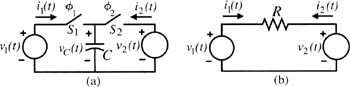
The first recorded use of switches and capacitors to emulate (measure) resistance is found in a text written by James Clerk Maxwell in 1873 [ [4]]. On pages 420 through 425 he describes how to measure the resistance of a galvanometer by connecting it in series with a battery, ammeter, and capacitor and periodically reversing the capacitor. Using a similar approach, we can illustrate how to emulate a resistor. Consider the switched capacitor circuit of Fig. 9.1-1(a). This configuration is called the parallel switched capacitor equivalent resistor. Next, we show how Fig. 9.1-1(a) is equivalent to the resistor R in Fig. 9.1-1(b).


Figure 9.1-1: (a) Parallel switched capacitor equivalent resistor. (b) Continuous time resistor of value R.

The parallel switched capacitor equivalent resistor circuit in Fig. 9.1-1(a) consists of two independent voltage sources, v 1( t) and v 2( t), two controlled switches, S 1 and S 2, and a capacitor, C. The switches, S 1 and S 2, are controlled by the clock waveforms. These clock waveforms are illustrated in Fig. 9.1-2. There...

UNLIMITED FREE
ACCESS
TO THE WORLD'S BEST IDEAS

SUBMIT
Already a GlobalSpec user? Log in.

This is embarrasing...

An error occurred while processing the form. Please try again in a few minutes.

Customize Your GlobalSpec Experience

Category: Capacitors
Finish!
Privacy Policy

This is embarrasing...

An error occurred while processing the form. Please try again in a few minutes.