Complete Wireless Design

If you want to climb the learning curve with grace, and start designing what you need immediately, this easy-to-understand guide will help you design an entire radio system from the ground up.
 TABLE OF CONTENTS
 A firm understanding of how passive and active components function at high frequencies, as well as a strong grasp of the fundamental concepts of lumped and distributed transmission lines, S-parameters, and radio-frequency (RF) propagation, is essential to successful circuit design.
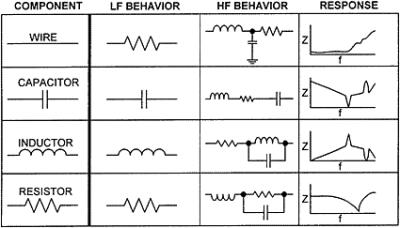
At radio frequencies, lumped (physical) resistors, capacitors, and inductors are not the pure components they are assumed to be at lower frequencies. As shown in Fig. 1.1, their true nature at higher frequencies has undesirable resistances, capacitances, and inductances which must be taken into account during design, simulation, and layout of any wireless circuit.
At microwave frequencies the lengths of all component leads have to be minimized in order to decrease losses due to lead inductance, while even the board traces that connect these passive components must be converted to transmission line structures. Surface mount devices (SMDs) are perfect for decreasing this lead length, and thus the series inductance, of any component (Fig. 1.2), while the most common transmission line structure is microstrip, which maintains a 50-ohm constant impedance throughout its length and without adding inductance or capacitance.
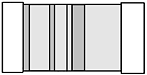
As the frequency of operation of any wireless circuit begins to increase, so does the requirement that the actual physical structure of all of the lumped components themselves be as small as possible, since the part s effective frequency of operation increases as...