Complete Wireless Design

If you want to climb the learning curve with grace, and start designing what you need immediately, this easy-to-understand guide will help you design an entire radio system from the ground up.
 TABLE OF CONTENTS
 Classes of operation. Special classes of amplifier bias levels are utilized to achieve different objectives, each with its own distinct advantages and disadvantages. The most prevalent classes of bias operation are Classes A, AB, B, and C. All of these classes use circuit components to bias the transistor at a different DC operating, or Q, point (Fig. 3.56).

As shown in Fig. 3.57, Class A bias permits a signal s amplified current to flow for the entire cycle, or 360 degrees, of the input signal. This allows the amplified output signal to never reach saturation or cutoff, and thus stay within linear operating parameters. The output will be a relatively accurate amplified representation of the input signal.
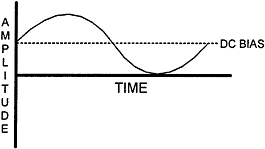
Because of their low efficiency, Class A single-ended amplifiers are ordinarily used only in small-signal, nonpower applications, especially as low-distortion linear RF and IF amplifiers. This lack of efficiency is caused by the large amount of continuous DC supply power required at all times to produce the constant current that is always flowing through the amplifier with or without any input signal present.
Simply by decreasing the Q point of the amplifier a small amount, Class AB operation is reached (Fig. 3.58). This class of operation has a little higher efficiency than Class A since the static output current ( I C