Complete Wireless Design

If you want to climb the learning curve with grace, and start designing what you need immediately, this easy-to-understand guide will help you design an entire radio system from the ground up.
 TABLE OF CONTENTS
 MMICs are monolithic microwave integrated circuits, typically containing a 50-ohm small-signal amplifier that requires very few support components for biasing, and none for impedance matching.
Figure 3.93 illustrates a very common MMIC package, with integral microstrip leads, for high-frequency operation. Some MMICs may have a separate DC power input pin on the package itself, which may be of the eight-pin dual in-line package (DIP) variety.
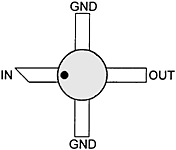
Even though a majority of amplifier MMICs are unconditionally stable, it is wise not to assume that all MMICs are. However, the manufacturer will usually warn you if the amplifier is potentially unstable, even if the warning is in small print at the bottom of the data sheet.
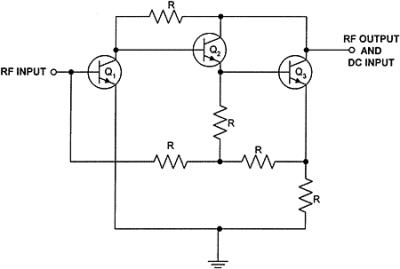
Taking the example of a high-quality and stable MMIC in the Agilent INA series of RFIC gain blocks, the internal structure is as shown in Fig. 3.94. This Agilent design employs a single transistor driving a Darlington pair, with a small resistive feedback to set the RF parameters. The single transistor has only a small amount of negative feedback for low-noise performance, with high gain into the DC coupled input of the Darlington pair. The Darlington pair has strong degenerative feedback, and sets the gain and matching of the RFIC, as well as the gain flatness.
The current-biased MMIC (by far the most common type), will attempt to draw...