Complete Wireless Design

If you want to climb the learning curve with grace, and start designing what you need immediately, this easy-to-understand guide will help you design an entire radio system from the ground up.
 TABLE OF CONTENTS
 A wideband MMIC or discrete amplifier is designed to have an extremely broad band of frequencies that it can pass with flat gain and (preferably) a decent return loss response along with perfect stability.
In order to properly design a discrete wideband RF amplifier we must suppress the lower frequencies, where the gain is the highest (Fig. 3.100a). One way to do this is by giving these frequencies a poor impedance match, while with the higher frequencies where the gain is much less we can give a perfect match. This will flatten the gain of the amplifier (Fig. 3.100b), but will not provide a high return loss at all frequencies. In other words, matching the transistor at high frequencies will supply more gain at these frequencies, while mismatching at the lower end of the spectrum will decrease the gain at these frequencies because of mismatch losses. However, stability is always of prime importance; since we now have various impedance mismatches across a wide bandpass and also at frequencies both below and above the bandwidth
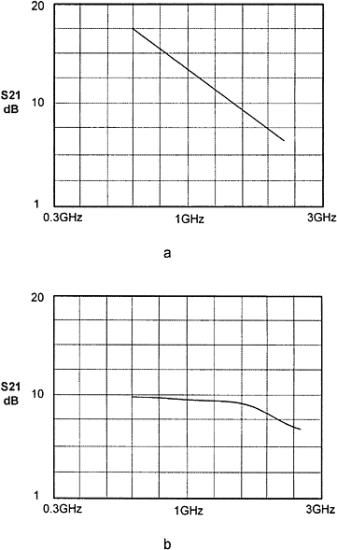
of the amplifier we want to be assured of stability at all frequencies. We can do this by checking with our S parameters that the small-signal active device will be unconditionally stable at all frequencies that are plotted within that particular S-parameter file. This, however, will not include the very lowest of frequencies,...