Die Design Fundamentals, 3rd Edition

A blank is a piece of flat steel or other material cut to any outside contour. The thickness of a blank may range between 0.001 and 0.500 inch (0.025 mm and 12.7 mm) or more depending on its function. However, most stampings are between 0.025 inch and 0.125 inch (0.6 and 3.2 mm) in thickness.
Some blanks have simple round, square, or rectangular contours. Others may be very irregular in shape. Many blanks are subsequently bent, formed, or drawn. It is important to realize, however, that when we refer to a blank, what is meant is the flat part before any deformation has been applied.
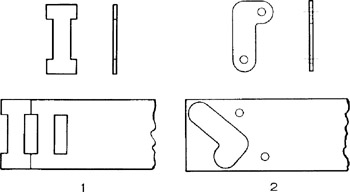
There are only two basic types of blanks (see Figure 4.1):
Blanks having straight, parallel sides, two of which are originally sides of the material strip (see view 1). Small blanks of this type are produced in cut-off dies. Large blanks are produced by square-shearing and trimming.
Blanks having irregular contours cut entirely out of the material strip (see view 2). When they are required in quantity, such blanks are produced in blanking dies. When only a few blanks are required, they may be shaped by contour sawing, nibbling, routing, or other machining operations.
To select the best method of producing a particular blank, consider five factors:
If the blank has two parallel sides, determine if it can be produced in a cut-off operation. The width between...