Die Design Fundamentals, 3rd Edition

Pilots play a vital role in the operation of multiple-station dies. Many press-line troubles can be traced to pilot faulty design. When applying pilots, the following factors should always be considered:
Pilots must be strong enough so that repeated shock will not cause fracture. Severe shock is applied to the pilot point more often than is realized. Consider that the pilot moves a heavy material strip almost instantly into register. Pilot breakage increases cost of the stamping because hundreds of inaccurate parts may be produced before failures are discovered. Also, there is the danger of costly jams resulting from a broken pilot falling between the cutting edges or forming members of the die.
Slender pilots must be sufficiently guided and supported to prevent bending, which can cause faulty strip-positioning. They should be made of a good grade of tool steel, heat-treated to 57-to-60 Rockwell C for maximum toughness and hardness.
Provision should be made for quick and easy removal of the pilots for punch sharpening.
There are two methods of piloting in progressive dies:
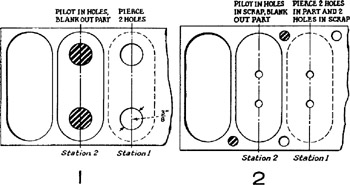
Direct piloting consists of piloting in holes pierced in that area of the strip that will become the blank.
Indirect piloting consists of piercing holes in the scrap area of the strip, then locating in these holes at subsequent operations.
Direct piloting is the preferred method, but certain blank conditions require indirect piloting. Figure 11.1 shows examples of direct piloting (1) and indirect piloting (2).