2.1 Introduction
In Chapter 1, we studied linear time-invariant systems, using both impulse responses and difference equations to characterize them. In this chapter, we study another very useful way to characterize discrete-time systems. It is linked with the fact that, when an exponential function is input to a linear time-invariant system, its output is an exponential function of the same type, but with a different amplitude. This can be deduced by considering that, from equation (1.38), a linear time-invariant discrete-time system with impulse response h( n), when excited by an exponential x( n) = z n, produces at its output a signal y( n) such that
| (2.1) | 
|
that is, the signal at the output is also an exponential z n, but with an amplitude multiplied by the complex function
| (2.2) | 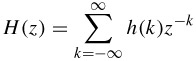
|
In this chapter, we characterize linear time-invariant systems using the quantity H( z) in the above equation, commonly known as the z transform of the discrete-time sequence h( n). As we will see later in this chapter, with the help of the z transform, linear convolutions can be transformed into simple algebraic equations. The importance of this for discrete-time systems parallels that of the Laplace transform for continuous-time systems.
The case when z n is a complex sinusoid with frequency ?, that is, z = e j ?, is of particular importance. In this case, equation (2.2) becomes


 TABLE OF CONTENTS