Digital Signal Processing: System Analysis and Design

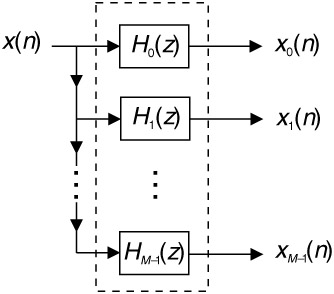
In some applications, such as signal analysis, signal transmission, and signal coding, a digital signal x( n) is decomposed into several frequency bands, as depicted in Figure 9.1.
In such cases, the signal in each of the bands x k( n) for k = 0, ..., M - 1, has at least the same number of samples as the original signal x( n). This implies that after the M-band decomposition, the signal is represented with at least M times more samples than the original one. However, there are many cases in which this expansion of the number of samples is highly undesirable. One such case is signal transmission (Vetterli & Kova?evi?, 1995), where more samples mean more bandwidth and consequently increased transmission costs.
In the common case where the signal is uniformly split in the frequency domain, that is, each of the frequency bands x k( n) has the same bandwidth, a natural question to ask is: since each band has bandwidth M times smaller than the one of the original signal, could the bands x k( n) be decimated by a factor of M (critically decimated) without destroying the original information? If this were possible, then one would have a digital signal decomposed into several frequency bands with the same overall number of samples as its original version.
In the...