9.6 CQF Filter Banks
In the QMF design designing the highpass filter from the lowpass prototype by alternating the signs of its impulse response is quite simple, but the possibility of getting perfect reconstruction is lost except in a few trivial cases. In Smith & Barnwell (1986), however, it was disclosed that by time-reversing the impulse response and alternating the signs of the lowpass filter, one can design perfect reconstruction filter banks with more selective sub-filters. The resulting filters became known as the conjugate quadrature filter (CQF) banks.
In the CQF design, we have that the analysis highpass filter is given by
| (9.65) | 
|
By verifying again that the order N of the filters must be odd, the filter bank transfer function is given by
| (9.66) | 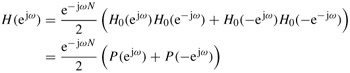
|
From equations (9.42) and (9.43), with c = -1 we have that, in order to guarantee perfect reconstruction, the synthesis filters should be given by
| (9.67) | 
|
| (9.68) | 
|
It is a fact that perfect reconstruction is achieved when the time-domain response of the filter bank equals a delayed impulse, that is
| (9.69) | 
|
Now, by examining H(e j?) in equation (9.66), one can easily infer that perfect reconstruction is equivalent to having the time-domain representation of P ( z) satisfying
| (9.70) | 
|
Therefore, the design procedure consists of the following steps:
-
Noting that p( n) = 0, for n even, except for n = (  - N), we start by designing a half-band filter, namely...


 TABLE OF CONTENTS