Digital Signal Processing: System Analysis and Design

In the previous chapters we studied different ways of describing discrete-time systems that are linear and time invariant. It was verified that the z transform greatly simplifies the analysis of discrete-time systems, especially those initially described by a difference equation.
In this chapter, we study several structures used to realize a given transfer function associated with a specific difference equation through the use of the z transform. The transfer functions considered here will be of the polynomial form (nonrecursive filters) and of the rational-polynomial form (recursive filters). We also analyze the properties of the given generic digital filter structures associated with practical discrete-time systems.
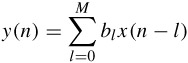
Nonrecursive filters are characterized by a difference equation in the form
| (4.1) | |
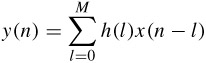
where the b l coefficients are directly related to the system impulse response, that is, b l = h( l). Due to the finite length of their impulse responses, nonrecursive filters are also referred to as finite-duration impulse-response (FIR) filters. We can rewrite equation (4.1) as
| (4.2) | |
Applying the z transform to equation (4.2), we end up with the following input-output relationship
| (4.3) | |
In practical terms, equation (4.3) can be implemented in several distinct forms, using as basic elements the delay, the multiplier, and the adder blocks. These basic elements of digital filters and their corresponding standard symbols are depicted in Figure 4.1. An alternative way of representing such elements is the so-called signal flowgraph shown in Figure...