3.1 Introduction
In Chapter 2, we saw that discrete-time signals and systems can be characterized in the frequency domain by their Fourier transform. Also, as seen in Chapter 2, one of the main advantages of discrete-time signals is that they can be processed and represented in digital computers. However, when we examine the definition of the Fourier transform in equation (2.173),
| (3.1) | 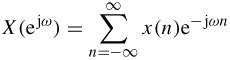
|
we notice that such a characterization in the frequency domain depends on the continuous variable ?. This implies that the Fourier transform, as it is, is not suitable for the processing of discrete-time signals in digital computers. As a consequence of (3.1), we need a transform depending on a discrete-frequency variable. This can be obtained from the Fourier transform itself in a very simple way, by sampling uniformly the continuous-frequency variable ?. In this way, we obtain a mapping of a signal depending on a discrete-time variable n to a transform depending on a discrete-frequency variable k. Such a mapping is referred to as the discrete Fourier transform (DFT).
In the main part of this chapter, we will study the DFT. First, the expression for the direct and inverse DFTs will be derived. Then, the limitations of the DFT in the representation of generic discrete-time signals will be analyzed. Also, a useful matrix form of the DFT will be presented.
Next, the properties of the DFT will be analyzed, with special emphasis given to the convolution property, which allows the computation of a discrete...


 TABLE OF CONTENTS