Discrete Stochastic Processes and Optimal Filtering
Concerned with the founding principles of optimal filters, this text presents several reminders about both random vectors and Gaussian vectors, and allows readers to tackle digital filtering.
 TABLE OF CONTENTS
 Let us begin by recalling the definitions and usual properties relative to 2 nd order random variables.
DEFINITIONS. Given X ? L 2 ( dP) of probability density f X, EX 2 and EX have a value. We call variance of X the expression:

We call standard deviation of X the expression 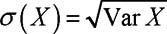 .
.
Now let two r.v. be X and Y ? L 2 ( dP). By using the scalar product <,> on L 2 ( dP) defined in 1.2 we have:

and, if the vector Z = ( X, Y) admits the density f Z, then:

We have already established, by applying Schwarz's inequality, that EXY actually has a value.
DEFINITION. Given that two r.v. are X, Y ? L 2 ( dP), we call the covariance of X and Y:
The expression Cov( X, Y) = EXY ? EXEY.
Some observations or easily verifiable properties:
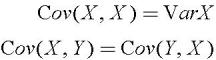
if ? is a real constant Var( ? X) = ? 2 Var X;
if X and Y are two independent r.v., then Cov( X, Y) = 0 but the reciprocal is not true;
if X 1, , X n are pairwise independent r.v.

The Var X j (always positive) and the Cov( X j