Discrete Stochastic Processes and Optimal Filtering

Concerned with the founding principles of optimal filters, this text presents several reminders about both random vectors and Gaussian vectors, and allows readers to tackle digital filtering.
 TABLE OF CONTENTS
 Wiener filtering is a method of estimating a signal perturbed by an added noise.
The response of this filter to the noisy signal, correlated with the signal to estimate, is optimal in the sense of the minimum in L 2.
The filter must be practically realizable and stable if possible, as a consequence its impulse response must be causal and the poles inside of the circle unit.
Wiener filtering is often used because of its simplicity, but despite this, the signals to be analyzed must be WSS processes.
Examples of applications, word processing, petrol exploration, surge movement, etc.
In Figure 5.1, X K, W K and Y K represent the 3 entry processes, h being the impulse response of the filter, Z K being the output of the filter which will give  which is an estimate at instant K of X K when the filter will be optimal. All the signals are necessarily WSS processes.
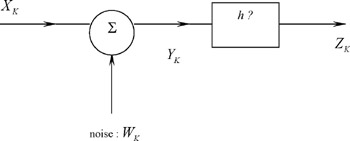
We will call:

the representative vector of the process of length N at the input of the realization filter:

h = ( h 0 h 1 h N ?1) T the vector representing the coefficients of the impulse response that we could identify with the vector ? of Chapter 4;
X K