Discrete Stochastic Processes and Optimal Filtering
Concerned with the founding principles of optimal filters, this text presents several reminders about both random vectors and Gaussian vectors, and allows readers to tackle digital filtering.
 TABLE OF CONTENTS
 We are examining two discrete time processes:

of the 2 nd order;
not necessarily wide sense stationary (WSS) (thus they do not necessarily have a spectral density).
 is called the state process and is the process (physical for example) that we are seeking to estimate, but it is not accessible directly.
 is called the observation process, which is the process we observe (we observe a trajectory
 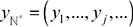 which allows us to estimate the corresponding trajectory
 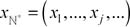 ).
).
A traditional example is the following:

where  is also a random process.
We thus say that the state of the process is perturbed by a parasite noise  . (perturbation due to its measurement, transmission, etc.).
In what follows, the hypothesis and data will be admitted:
 X j and Y j ? L 2 ( dP);
 , we know EX j, cov ( X i, Y j), cov ( Y i, Y j).
PROBLEM. Having observed (or registered) a trajectory  of
of  up to the instant K ? 1, we want, for a given instant p, to determine the value "
  which best approaches x p (unknown)".
 and
and 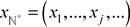 which is unknown
If:
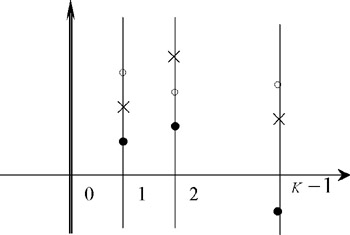
p < K ? 1 we speak of smoothing;
p = k ? 1 we speak of filtering;
p > K ? 1 we speak of prediction.
| Note | 1. ... |