Dynamics of Multibody Systems, Third Edition

In multibody systems, the system coordinates are not independent because of the specified motion trajectories as well as mechanical joints such as universal, prismatic, and revolute joints. These kinematic constraints can be introduced to the dynamic formulation by using a set of nonlinear algebraic constraint equations that depend on the system generalized coordinates and possibly on time. One can write the vector of all kinematic constraint functions as
| (5.114) | |
where
is the total vector of system generalized coordinates, t is time,
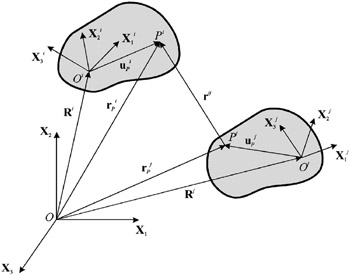
is the vector of linearly independent constraint functions, and n c is the number of constraint equations. For example, we may consider the two-body system shown in Fig. 5; one may require that the motion of point P i on body i relative to point P j on body j be specified, that is,
| (5.115) | |
where f( t) is a time-dependent vector function and r ij is the position vector of point P i relative to point P j. This relative position vector can be written as
| (5.116) | |
Using Eq. 115 and writing u i and u j in a more explicit form, one obtains
| (5.117) | |
where
and
are, respectively, the positions of points P i and P j in the undeformed state and S i and S j are the shape functions of the two bodies evaluated at...