Dynamics of Multibody Systems, Third Edition

Having determined, in the preceding sections, the kinetic energy of the deformable body i, the virtual work of the internal and external forces, and the kinematic constraints that describe mechanical joints as well as specified trajectories, one can use Lagrange s equation developed in Chapter 3 to write the system equations of motion of body i in the multibody system. To this end, we write the virtual work of the forces acting on body i as
| (5.124) | |
where ?W i is the virtual work of all forces acting on body i,
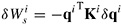
is the virtual work of the elastic forces resulting from the deformation of the body, and
is the virtual work due to externally applied forces. These forces include gravity effect, spring and damping forces acting between the system components, and control forces. It was shown in the preceding sections that (Eq. 106)
| (5.125) | |
where K i is the stiffness matrix of the ith body and q i is the total vector of generalized coordinates of body i.
It has also been shown that the virtual work of externally applied forces
can, in general, be written in the form
| (5.126) | |
where
is the vector of generalized forces associated with the generalized coordinates of body i. Equations 124 126 lead to
| (5.127) | |
This can be written as
| (5.128) | |
where Q i is the vector of generalized forces associated with the coordinates of body