EIT Chemical Review, Second Edition

Chapter 4: Mass Transfer

Overview

Mass transfer involves movement of molecules under some driving force such as concentration or temperature difference. However, mass transfer discussed here will be primarily dealing with concentration difference. Mass transfer takes place by two mechanisms (1) Molecular diffusion (2) Convective diffusion

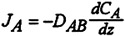
Fick's law: This basic relation for mass transfer by molecular diffusion in a binary mixture of A and B is given by

Where

J A

=

Molar flux of component A along axis z and moving at molar average velocity

D AB

=

Diffusivity of A in the solution containing A and B

C A

=

Concentration of A

z

=

Distance coordinate in the direction of molecular diffusion

Another expression for the same case is J A = - c mD AB

where y A is mol fraction of A and c m is average molar density of the mixture.

Estimation of binary diffusivities:

For gases, an empirical equation to calculate diffusivity of a component in a binary mixture is as follows

where v is the atomic diffusion volume of a simple molecule and other symbols have usual meaning e.g.

p = pressure. ? v's are obtained by summation of the atomic diffusion volumes.

Theoretical equation for calculation of diffusivity in binary gas mixtures at low-pressures is

Where T = temperature K, M A and M B = molecular weights, P = Pressure, atm,

? D = f( kT/ ? AB), collision integral, k...

UNLIMITED FREE
ACCESS
TO THE WORLD'S BEST IDEAS

SUBMIT
Already a GlobalSpec user? Log in.

This is embarrasing...

An error occurred while processing the form. Please try again in a few minutes.

Customize Your GlobalSpec Experience

Category: Density and Specific Gravity Instruments
Finish!
Privacy Policy

This is embarrasing...

An error occurred while processing the form. Please try again in a few minutes.