EIT Chemical Review, Second Edition

FLUID HANDLING EQUIPMENT
Centrifugal Pumps
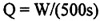
Relation between volumetric flow rate,Q, and mass flow rate,W
| (10-1) | |
Net Positive Suction Head Available(NPSH A)
| (10-2a) | |
When NPSH is determined from the gage reading at the pump suction:
| (10-2b) | |
NPSH A must always be positive, and greater than NPSH required.
Suction Pressure, P s
| (10-3) | |
Discharge Pressure, P d
| (10-4) | |
Total dynamic head, TDH.
TDH is independent of fluid density, although horsepower, discharge pressure etc. would change with density.
| (10-5) | ![]() |
Hydraulic horsepower, hhp
| (10-6) | ![]() |
Brake horsepower, bhp
| (10-7) | |
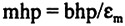
Motor horsepower, mhp
| (10-8) | |
Maximum temperature rise due to pumping, assuming all power input goes to heat the fluid, ?T
| (10-9a) | |
| (10-9b) | |
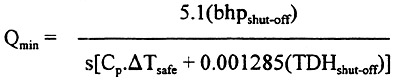
Minimum recirculation flow.
When a running pump is put on a standby mode, such as in a batch operation, a minimum flow,Q min, is to be drawn from the pump back to the suction vessel, normally through a restriction orifice, for thermal protection of the pump.
| (10-10) | ![]() |
?T safe = Saturation temperature corresponding to [P v + (0.433s)NPSH] - operating temperature, F
This minimum flow should be added to the maximum demand to estimate the design capacity of a batch pump expected to run on a standby mode.
There is still another minimum flow called the mechanical minimum flow which should be maintained to avoid excessive vibration and shaft deflection due to unbalanced radial loads. This flow is supplied by the manufacturer of the pump. The final minimum flow should be greater of the two.