Electrical Engineering License Review, Eigth Edition
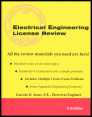
This text provides a comprehensive revew detailing all exam topics for the State Electrical Engineers exam for the Practicing Engineers license. It also contains 100+ problems and a sample exam.
 TABLE OF CONTENTS
 The majority of this chapter is based upon analysis and design methods using classical control system techniques (in contrast to the state variable method of analysis). In the past, most control system problems were classic in nature (i.e., the method of solution is by using root locus, Bode and Nyquist plots, etc.). In this author's opinion, the bulk of most problems will continue to be in the classical format; future problems may possibly include both state variable conversion and discrete systems involving the z- transform. If the reader has extra study time, a very short review of state variable conversion will be presented along with an introductory review of discrete (sampled data) systems at the end of the chapter. No attempt will be made to cover direct digital control; however, in the next chapter, some references will be made to this subject.
The background for this chapter requires a good understanding of Laplace transforms, pole-zero maps, and RLC transient response analysis. Considerable use of the standardized second-order differential equation solutions will be the basic building block for notational purposes.
Control is concerned with regulation or control of the output, where some attribute of the output, by means of feedback, is part of this control. The analysis of a system usually involves three areas of concern:
Problem Formulation. This involves making a mathematical model of the various parameters of the system; normally this involves first finding the differential equation of the open loop system, then converting to Laplace transforms. The...