Electrical Engineering License Review, Eigth Edition

This text provides a comprehensive revew detailing all exam topics for the State Electrical Engineers exam for the Practicing Engineers license. It also contains 100+ problems and a sample exam.
 TABLE OF CONTENTS
 A typical situation is a cash flow representing the costs and benefits. The rate of return may be defined as the interest rate where PW of cost = PW of benefits, EUAC = EUAB, or PW of cost ? PW of benefits = 0.
Compute the rate of return for the investment represented by the following cash flow table.
| Year: | 0 | 1 | 2 | 3 | 4 | 5 |
| Cash Flow: | ?$595 | +250 | +200 | +150 | +100 | +50 |
Solution
This declining uniform gradient series may be separated into two cash flows for which compound interest factors are available.
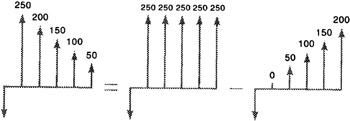
Note that the gradient series factors are based on an increasing gradient. Here the declining cash flow is solved by subtracting an increasing uniform gradient, as indicated in the figure.
PW of cost ? PW of benefits = 0

Try i = 10%:

Try i = 12%

The rate of return is between 10% and 12%. It may be computed more accurately by linear interpolation:

Compute the incremental rate of return on the cash flow representing the difference between the two alternatives. Since we want to look at increments of investment, the cash flow for the difference between the alternatives is computed by taking the higher initial-cost alternative minus the lower initial-cost alternative. If the incremental rate of return is greater than or equal to the predetermined minimum attractive rate of return (MARR), choose the higher-cost alternative; otherwise, choose...