Electrical Engineering License Review, Eigth Edition
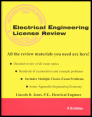
This text provides a comprehensive revew detailing all exam topics for the State Electrical Engineers exam for the Practicing Engineers license. It also contains 100+ problems and a sample exam.
 TABLE OF CONTENTS
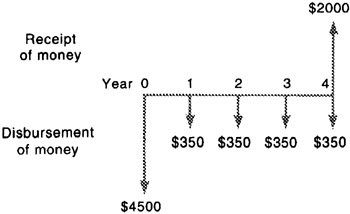
 A cash flow table shows the "money consequences" of a situation and its timing. For example, a simple problem might be to list the year-by-year consequences of purchasing and owning a used car:
| Year | Cash Flow | |
|---|---|---|
| Beginning of first Year 0 | ?$4500 | Car purchased "now" for $4500 cash. The minus sign indicates a disbursement. |
| End of Year 1 | ?350 | Maintenance costs are $350 per year. |
| End of Year 2 | ?350 | |
| End of Year 3 | ?350 | |
| 350 | ||
| End of Year 4 | +2000 | The car is sold at the end of the 4th year for $2000. The plus sign represents a receipt of money. |
This same cash flow may be represented graphically, as shown in Fig. A-1. The upward arrow represents a receipt of money, and the downward arrows represent disbursements. The horizontal axis represents the passage of time.
In January, 1993 a firm purchased a used typewriter for $500. Repairs cost nothing in 1993 or 1994. Repairs are $85 in 1995, $130 in 1996, and $140 in 1997. The machine is sold in 1997 for $300. Compute the cash flow table.
Solution
Unless otherwise stated, the customary assumption is a beginning-of-year purchase, followed by end-of-year receipts or disbursements, and an end-of-year resale or salvage value. Thus the typewriter repairs and the typewriter sale are assumed to occur at the end of the year. Letting a minus sign represent a disbursement of money, and a plus sign a receipt of...