Electrical Engineering License Review, Eigth Edition

This text provides a comprehensive revew detailing all exam topics for the State Electrical Engineers exam for the Practicing Engineers license. It also contains 100+ problems and a sample exam.
 TABLE OF CONTENTS
 Present-Worth analysis converts all of the money consequences of an alternative into an equivalent present sum. The criteria are listed here:
| Category | Present-Worth Criterion |
|---|---|
| Fixed Input | Maximize the Present Worth of benefits or other outputs. |
| Fixed Output. | Minimize the Present Worth of costs or other inputs |
| Neither Input nor Output fixed. | Maximize Present Worth of benefits minus Present Worth of costs, or Maximize Net Present Worth. |
Present-Worth analysis is most frequently used to determine the present value of future money receipts and disbursements. We might want to know, for example, the present worth of an income producing property, like an oil well. This should provide an estimate of the price at which the property could be bought or sold.
An important restriction in the use of present worth calculations is that there must be a common analysis period when comparing alternatives. It would be incorrect, for example, to compare the present worth (PW) of cost of Pump A, expected to last 6 years, with the PW of cost of Pump B, expected to last 12 years (Fig. A-8). In situations like this, the solution is either to use some other analysis technique (generally the annual cost method is suitable in these situations) or to restructure the problem so there is a common analysis period.
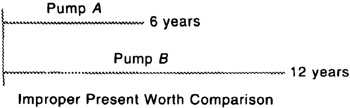
In the example above, a customary assumption would be that a pump is needed for 12 years and that Pump A will be replaced by an identical...