Electrical Power Systems Quality, Second Edition
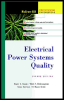
This book provides a non-mathematical guide to basic power-quality strategies and methods used to protect electronic systems.
 TABLE OF CONTENTS
 Voltage sags and interruptions are related power quality problems. Both are usually the result of faults in the power system and switching actions to isolate the faulted sections. They are characterized by rms voltage variations outside the normal operating range of voltages.
A voltage sag is a short-duration (typically 0.5 to 30 cycles) reduction in rms voltage caused by faults on the power system and the starting of large loads, such as motors. Momentary interruptions (typically no more than 2 to 5 s) cause a complete loss of voltage and are a common result of the actions taken by utilities to clear transient faults on their systems. Sustained interruptions of longer than 1 min are generally due to permanent faults.
Utilities have been faced with rising numbers of complaints about the quality of power due to sags and interruptions. There are a number of reasons for this, with the most important being that customers in all sectors (residential, commercial, and industrial) have more sensitive loads. The influx of digital computers and other types of electronic controls is at the heart of the problem. Computer controls tend to lose their memory, and the processes that are being controlled also tend to be more complex and, therefore, take much more time to restart. Industries are relying more on automated equipment to achieve maximum productivity to remain competitive. Thus, an interruption has considerable economic impact. [1], [3]
[1]J. Lamoree, J. C. Smith, P. Vinett, T. Duffy, M. Klein, "The...