Electrical Power Systems Quality, Second Edition
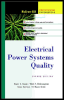
This book provides a non-mathematical guide to basic power-quality strategies and methods used to protect electronic systems.
 TABLE OF CONTENTS
 There are a number of devices available to control harmonic distortion. They can be as simple as a capacitor bank or a line reactor, or as complex as an active filter.
As described in Sec. 6.2, a simple mitigation action such as adding, resizing, or relocating a shunt capacitor bank can effectively modify an unfavorable system frequency response, and thus bring the harmonic distortion to an acceptable level. Similarly, a reactor can perform the same function by detuning the system off harmful resonances. The effectiveness of such simple solutions in controlling harmonic distortion should be explored prior to considering a more complex device.
The following material first discusses the effectiveness of a simple inline reactor, or choke, in mitigating harmonic distortion. Then, two general classes of harmonic filters, i.e., passive and active filters, are discussed. The former are based on passive elements, while the latter are based on power electronic devices.
A simple, but often successful, method to control harmonic distortion generated by adjustable-speed drives involves a relatively small reactor, or choke, inserted at the line input side of the drive. This is particularly effective for PWM-type drives.
The inductance slows the rate at which the capacitor on the dc bus can be charged and forces the drive to draw current over a longer time period. The net effect is a lower-magnitude current with much less harmonic content while still delivering the same energy.
A typical 3 percent input...