Electrical Power Systems Quality, Second Edition
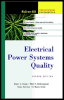
This book provides a non-mathematical guide to basic power-quality strategies and methods used to protect electronic systems.
 TABLE OF CONTENTS
 A good assumption for most utilities in the United States is that the sine-wave voltage generated in central power stations is very good. In most areas, the voltage found on transmission systems typically has much less than 1.0 percent distortion. However, the distortion increases closer to the load. At some loads, the current waveform barely resembles a sine wave. Electronic power converters can chop the current into seemingly arbitrary waveforms.
While there are a few cases where the distortion is random, most distortion is periodic, or an integer multiple of the power system fundamental frequency. That is, the current waveform is nearly the same cycle after cycle, changing very slowly, if at all. This has given rise to the widespread use of the term harmonics to describe distortion of the waveform. This term must be carefully qualified to make sense. This chapter and Chap. 6 remove some of the mystery of harmonics in power systems.
When electronic power converters first became commonplace in the late 1970s, many utility engineers became quite concerned about the ability of the power system to accommodate the harmonic distortion. Many dire predictions were made about the fate of power systems if these devices were permitted to exist. While some of these concerns were probably overstated, the field of power quality analysis owes a great debt of gratitude to these people because their concern over this "new" problem of harmonics sparked the research that has eventually led to much of the knowledge about all...