Electrical Power Systems Quality, Second Edition
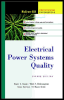
This book provides a non-mathematical guide to basic power-quality strategies and methods used to protect electronic systems.
 TABLE OF CONTENTS
 There are two main sources of transient overvoltages on utility systems: capacitor switching and lightning. These are also sources of transient overvoltages as well as a myriad of other switching phenomena within end-user facilities. Some power electronic devices generate significant transients when they switch. As described in Chap. 2, transient overvoltages can be generated at high frequency (load switching and lightning), medium frequency (capacitor energizing), or low frequency.
Capacitor switching is one of the most common switching events on utility systems. Capacitors are used to provide reactive power (in units of vars) to correct the power factor, which reduces losses and supports the voltage on the system. They are a very economical and generally trouble-free means of accomplishing these goals. Alternative methods such as the use of rotating machines and electronic var compensators are much more costly or have high maintenance costs. Thus, the use of capacitors on power systems is quite common and will continue to be.
One drawback to the use of capacitors is that they yield oscillatory transients when switched. Some capacitors are energized all the time (a fixed bank), while others are switched according to load levels. Various control means, including time, temperature, voltage, current, and reactive power, are used to determine when the capacitors are switched. It is common for controls to combine two or more of these functions, such as temperature with voltage override.
One of the common symptoms of power quality problems related to utility...