Electrical Power Systems Quality, Second Edition
This book provides a non-mathematical guide to basic power-quality strategies and methods used to protect electronic systems.
 TABLE OF CONTENTS
 Utilities generally try to maintain the service voltage supplied to an end user within 5 percent of nominal. Under emergency conditions, for short periods, ANSI Standard C84.1 permits the utilization voltage to be in the range of +6 to ?13 percent of the nominal voltage. Some sensitive loads have more stringent voltage limits for proper operation and, of course, equipment generally operates more efficiently at near nominal voltage. This chapter addresses the fundamental problems behind voltage regulation and the general types of devices available to correct the problem.
The root cause of most voltage regulation problems is that there is too much impedance in the power system to properly supply the load (Fig. 7.1). Another way of describing this is to say that the power system is too weak for the load. Therefore, the voltage drops too low under heavy load. Conversely, when the source voltage is boosted to overcome the impedance, there can be an overvoltage condition when the load drops too low. The corrective measures usually involve either compensating for the impedance Z or compensating for the voltage drop IR + jIX caused by the impedance.
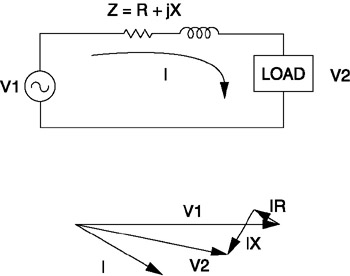
Some common options for improving power system voltage regulation, in the approximate order of priority that a utility might apply, are
Add shunt capacitors to reduce the current I and shift it to be more...