Electrical Power Systems Quality, Second Edition
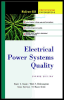
This book provides a non-mathematical guide to basic power-quality strategies and methods used to protect electronic systems.
 TABLE OF CONTENTS
 There are various organizations on the national and international levels working in concert with engineers, equipment manufacturers, and research organizations to come up with standards governing guidelines, recommended practices, and harmonic limits. The primary objective of the standards is to provide a common ground for all involved parties to work together to ensure compatibility between end-use equipment and the system equipment is applied. An example of compatibility (or lack of compatibility) between end-use equipment and the system equipment is the fast-clock problem in the case study given in Sec. 6.7.2. The end-use equipment is the clock with voltage zero-crossing detection technology, while the system yields a voltage distorted with harmonics between 30th and 35th. This illustrates a mismatch of compatibility that causes misoperation of the end-use equipment.
This section focuses on standards governing harmonic limits, including IEEE 519-1992, IEC 61000-2-2, IEC 61000-3-2, IEC 61000-3-4, IEC 61000-3-6, NRS 048-2, [13] and EN50160. [14]
The limits on harmonic voltage and current based on IEEE Standard 519-1992 are described in Sec. 6.1. It should be emphasized that the philosophy behind this standard seeks to limit the harmonic injection from individual customers so that they do not create unacceptable voltage distortion under normal system characteristics and to limit the overall harmonic distortion in the voltage supplied by the utility. The voltage and current distortion limits should be used as system design values for the worst case of normal operating conditions lasting more than 1 h.