Error-Control Block Codes for Communications Engineers
An engineer s guide to the theory behind the common random-error-control block codes, and their applications in digital communications.
 TABLE OF CONTENTS
 Let us consider the following examples where k number of information digits are fed into a channel encoder and n number of encoded digits are produced by the channel encoder. This is shown in Figure 3.2.

Consider the case where q = 2, k = 3, and n = 3. The codewords are {0 0 0, 0 0 1, 0 1 0, 0 1 1, 1 0 0, 1 0 1, 1 1 0, 1 1 1}. Clearly, the codewords contain no redundancy if k = n. A single error will carry one transmitted codeword into another codeword, and the error will not be detected.
Consider the case where q = 2, k = 2, and n = 3. There are 2 k = 4 possible input patterns and 2 n = 8 possible output patterns. A possible encoding rule is shown in Table 3.1.
| Information Vector U | Codeword V |
|---|---|
| 0 0 | 0 0 0 |
| 0 1 | 0 1 1 |
| 1 0 | |
| 1 1 |
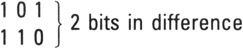
If 1 0 1 is transmitted, an error pattern E = [0 0 1] will convert 1 0 1 to 1 0 0, the received vector R. If the channel decoder has a complete knowledge of Table 3.1 and chooses the output pattern corresponding...