Error-Control Block Codes for Communications Engineers
An engineer s guide to the theory behind the common random-error-control block codes, and their applications in digital communications.
 TABLE OF CONTENTS
 Suppose that a code vector V = [ v 0 v 1 . . . v n ?1] is transmitted. In the presence of noise, the received vector R = [ r 0 r 1. . . r n ?1] may not be the same as the transmitted vector. The decoder computes the ( n ? k)-tuple:
| (3.30) | 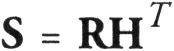 |
where H T is the transpose of the parity-check matrix of the ( n, k) linear code and S is the syndrome of R. In the presence of errors:
| (3.31) |  |
where R = [ r 0 r 1. . . r n ?1] is the received word, V = [ v 0 v 1 . . . v n ?1] is the transmitted codeword, and E = [ e 0 e 1 . . . e n ?1] is the error pattern.
For ( n, k) systematic linear code with an information vector U = [ u 0 u 1 . . . u k ?1], the transmitted codeword V becomes
| (3.32) |  |
and equation (3.30) becomes
| (3.33) | 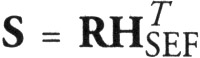 |
where
| (3.34) |  |
Based on equations (3.14) and (3.34), equation (3.33) can be written as,
| (3.35) | 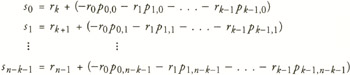 |
It can be seen that the first term corresponds to the received parity-check digit and the remaining terms correspond to the recalculated parity-check...