Error-Control Block Codes for Communications Engineers
An engineer s guide to the theory behind the common random-error-control block codes, and their applications in digital communications.
 TABLE OF CONTENTS
 We have seen that the problem of finding a code with a given degree of error protection reduces to that of finding a code with a given minimum distance. Unfortunately, there is no general rule for finding codes with a given d min. The construction of some simple and well-known binary linear block codes is presented here.
Repetition is the simplest form of error protection. Each information digit may be transmitted n times. The generator and parity-check matrices of an ( n, 1) binary repetition block code are
| (3.21) |  |
and
| (3.22) | 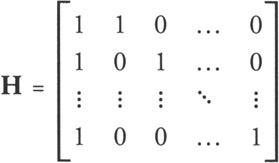 |
respectively. It can be seen that the minimum Hamming distance of an ( n, 1) repetition block code is n. In general, n transmissions of the same digit enable n ? 1 errors to be detected, or ?( n ? 1)/2 errors to be corrected.
A single-parity-check code of block length n may be formed by taking a parity-check over k = n ? 1 information digits. The parity-check digit v n ?1 may be written as
| (3.23) |  |
where + implies modulo-2 addition. We chose an even-parity rule so that each codeword has an even number of ones. The generator and parity-check matrices of an ( n, n ? 1) binary single-parity-check block code are
| (3.24) | 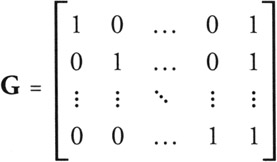 |
and
| (3.25) |  |
respectively. Single, triple, and all odd number of errors in the block n