Error-Control Block Codes for Communications Engineers
An engineer s guide to the theory behind the common random-error-control block codes, and their applications in digital communications.
 TABLE OF CONTENTS
 R. W. Hamming found an optimum class of single-error correcting codes in 1950 [6]. The code was used for long-distance telephony. For some integers c ? 2, the family of binary Hamming codes has the following parameters:
| Block length: | n = 2 c ? 1 |
| Information digits: | k = 2 c ? c ? 1 |
| Number of check digits: | c = n ? k |
| Minimum distance: | d min = 3 |
| Error correcting capability: | t' = 1. |
To construct the parity-check matrix of an ( n, k) binary Hamming code, we simply place all nonzero binary c-tuples in the columns of the c-by- n parity-check matrix in any order.
For example, the parity-check and the corresponding generator matrices of a (7, 4) single-error-correcting binary Hamming code are
| (3.27) | 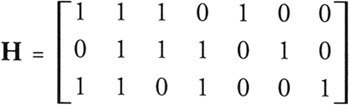 |
and
| (3.28) | 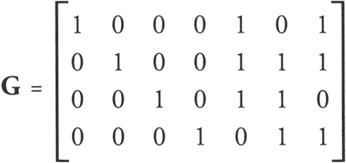 |
If the input information sequence is U = [0 1 1 1], the encoded code sequence is V = UG = [0 1 1 1 0 1 0].