Error-Control Block Codes for Communications Engineers
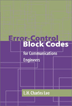
An engineer s guide to the theory behind the common random-error-control block codes, and their applications in digital communications.
 TABLE OF CONTENTS
 Since Shannon's work in 1948 [1], error-control block and convolutional coding has been an active area for research and has found its applications in many practical systems. Most of the early work in error-control coding was mainly devoted to space communication systems where power was limited and the bandwidth is not a major concern. The goal was simply to reduce the power requirement and achieve Shannon's channel capacity limit. Error-control coding has also found its applications in the bandwidth-limited region of satellite communications, and mobile communications. There, the goal is to reduce power requirements and increase spectral efficiency. Recently, Reed-Solomon codes have applied to digital audio recording systems. This chapter describes applications of error-control block coding techniques to space communications, mobile communications, and the compact disc digital audio recording system.
In deep-space communications, the received signal power usually is weak at the earth station. Noise is additive white Gaussian, and the errors are random in nature. A large error-correcting capability is needed. Because the bandwidth is not restricted, it is possible to build a complex channel decoder. Therefore, low-rate, powerful, error-correcting codes with soft-decision decoding are often used. Code concatenation is also a possibility to improve system performance [2].
In 1977, the Voyager spacecraft was launched to explore the outer planets. It reached the planets Jupiter and Saturn in 1979 and 1981, respectively. Pictures of those planets were sent back to earth stations. Two convolutional codes were designed at...