EW 102: A Second Course in Electronic Warfare

This chapter describes and discusses radar concepts and systems from the EW point of view. We will be looking at various types of radars to determine what they do, how they do it, and what their signals look like when viewed by an intercepting receiver. We will cover radar processing only to the level necessary to be able to discuss subjects like resolution, detection range, detectability, and vulnerability to jamming. Appendix C includes several recommended reference books that provide much more detail on radar theory and systems.
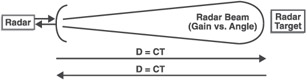
The function of radar is to locate things by determining their range and angular position relative to the radar location and orientation. A radar determines the distance to some object (which we will call the target) by measuring the time it takes a propagated signal to travel to and from the target at the speed of light (see Figure 3.1). The range to the target is the speed of light multiplied by half of the time from the transmission of a signal to the reception of the same signal reflected from the target.
A radar determines the angular position of the target by means of a directional antenna with a gain pattern which varies as a function of angle from the antenna boresight. By comparing the amplitude...