EW 102: A Second Course in Electronic Warfare

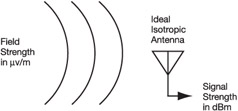
When describing the communications link, we define the signal leaving the transmit antenna as effective radiated power in dBm. This is not literally true, since dBm is only defined inside a circuit. Out in the propagation medium (atmosphere or space) the signal is accurately defined in terms of field strength, and the proper units are microvolts per meter. However, it is extremely convenient to describe signal levels in dBm through the whole link, so we use an artifice to make it work. The artifice is to describe the signal level in space as the power in dBm that would be received by an isotropic (omnidirectional) antenna as shown in Figure 5.10. If this ideal antenna receives the signal anywhere in the signal transmission path, the antenna output is properly in dBm.
Since receiver sensitivity and some other important items can be specified in microvolts per meter, we are sometimes required to convert back and forth between field strength and equivalent signal strength in dBm in order to work propagation problems. The conversion is done by squaring the field strength value, multiplying by the equivalent area of the isotropic antenna, and dividing by the impedance of free space.
The effective area of an antenna is given by the formula:
A = G ? 2/4 ?
where
A = the antenna area...