EW 102: A Second Course in Electronic Warfare

Chapter 4: Infrared and Electro-optical Considerations in Electronic Warfare

The object of electronic warfare is to deny an enemy the benefits of the electromagnetic spectrum while preserving those benefits for our own forces. It is easy to fall into the trap of considering only the radio frequency part of the electromagnetic spectrum, but there is a significant amount of EW effort in the IR, visible light, and ultraviolet parts of the electromagnetic spectrum. In this chapter, we will deal with the general nature of these parts of the spectrum, the systems that operate in this range, and the nature of the countermeasures against those systems.

4.1 The Electromagnetic Spectrum

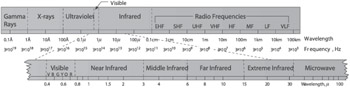
Figure 4.1 shows the portion of the electromagnetic spectrum that is of most interest to the electronic warfare field. Although we typically use frequency to define the RF portions of the spectrum, it is more common to use wavelength at the higher frequencies. Note that wavelength and frequency are related by the speed of light in the formula:

c= f ?


Figure 4.1: The electromagnetic spectrum includes RF, IR, visible, and above-visible frequencies.

where

c = the speed of light (3 10 8 m/s);

f = frequency (in hertz);

? = wavelength (in meters).

Frequencies below 300 GHz (i.e., wavelengths longer than 0.1 cm) are in the radio frequency range. Above that frequency, we'll only talk about the wavelengths. The common unit of wavelength is the micron (10 -6 meter) which is abbreviated ? At very short wavelengths, angstroms are used (10 -10

UNLIMITED FREE
ACCESS
TO THE WORLD'S BEST IDEAS

SUBMIT
Already a GlobalSpec user? Log in.

This is embarrasing...

An error occurred while processing the form. Please try again in a few minutes.

Customize Your GlobalSpec Experience

Category: Optical Filters
Finish!
Privacy Policy

This is embarrasing...

An error occurred while processing the form. Please try again in a few minutes.