EW 102: A Second Course in Electronic Warfare

In this chapter, we will deal with EW related to communications signals. Subjects will include radio propagation, the nature of the threat environment, and individual signal characteristics. It will also include discussions of search, intercept, and jamming issues relative to communication signals. The tactical communication environment is extremely dense in battlefield situations, which is an important consideration in all communications EW activities.
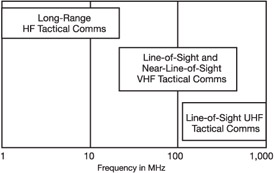
Tactical communication is primarily conducted in the HF, VHF, and UHF frequency ranges as shown in Figure 5.1. However, there are also fixed point-to-point, satellite, and air-to-ground data links that must be considered communication signals as well. Table 5.1 lists the typical uses of communication links in each category.
| Military Application | Type of Link | Frequency Range |
|---|---|---|
| Tactical command and control (ground) | Ground point-to-point and air-to-ground | HF, VHF, UHF |
| Tactical command and control (air) | Air-to-ground and air-to-air | VHF, UHF |
| UAV command and data | Air-to-ground and air relay; satellite | Microwave |
| Strategic command and control | Satellite | Microwave |
In general, the higher the frequency, the more dependent a communication link is on a clear line of sight between the transmitter and receiver but the more bandwidth is available. There are also unique considerations for each band.