EW 102: A Second Course in Electronic Warfare

Radio propagation in the VHF and UHF frequency ranges is "better behaved" than HF propagation. That is, the VHF and UHF propagation can be better described by formulas. In this section, we will discuss the commonly used propagation models and their normal application. Note that we are considering only the losses related to link geometry. There are additional losses from atmosphere and rain, but in this frequency range, they are usually not too significant.
Chapter 84 (page 1182) of the Communications Handbook is an excellent reference for propagation models. It discusses both the simple and the complex models. It includes coverage of the Okumura, Hata, and Walfish and Bertoni models for outdoors propagation and the Saleh and SIRCIM models for indoor propagation. These models input specific path characteristics and thus provide valuable information for fixed-location communication, but they are less useful in electronic warfare. EW propagation typically deals with dynamic scenarios involving large numbers of actual and potential links. Therefore, we usually use either the free space, two-ray, or knife-edge diffraction propagation models in EW applications.
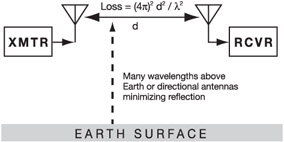
As shown in Figure 5.6, the free space propagation (also sometimes called line-of-sight) model is appropriate for propagation where there are no significant reflection paths. This occurs at high frequencies and high altitudes, but also occurs when narrow-beam antennas reduce the impact of reflection paths on the propagation.
The...