EW 102: A Second Course in Electronic Warfare

In this section, we will review LPI signals as a prelude to our discussions about jamming them. These signals spread their energy (pseudorandomly) across a wider frequency range than required to just carry their information from the transmitter to the receiver. Thus, they are also called spread spectrum signals. The minimum bandwidth required for a communication transmission is the "information bandwidth." The "transmission bandwidth" is the frequency over which the signal is spread.
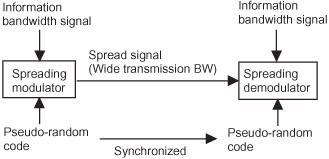
The desired receiver for a spread spectrum signal has dispreading capability that is synchronized to the spreading circuitry in the transmitter allowing the receiver to process the signal in its original, unspread form as shown in Figure 5.24. A hostile receiver does not have the synchronized dispreading capability. Thus, signal intercept and jamming and emitter location are greatly complicated. The noise power in a receiver is proportional to its effective bandwidth. Thus, the noise power in a hostile receiver with enough bandwidth to receive the spread spectrum signal will be high enough to hide the signal.
There are three basic types of spread spectrum signals: frequency hopping, chirp, and direct sequence. Each approach spreads the signal. However, the nature of the power versus frequency versus time distribution for each type of modulation gives it different vulnerability to intercept, location, and jamming.
As shown in Figure 5.25, frequency-hopping (FH) signals periodically move...