EW 102: A Second Course in Electronic Warfare

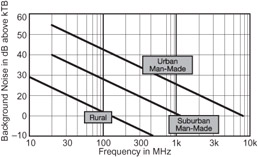
The chart in Figure 5.11 shows the background noise in various environments as a function of frequency. It is called external noise because it is not generated within the receiver. External noise is the combined emissions from many lowpower interfering signals, such as engine spark plugs, trolley cars, and electric motors. Note that it is very strong in medium- and high-frequency (MF and HF) ranges and diminishes with increasing frequency.
Atmospheric noise is mainly from lightning discharges. It is dependent on frequency, time of day, weather, season of the year, and geographical location.
Cosmic noise is from the sun and the stars. It is highest in the Galactic plane.
Urban and suburban noise is manmade noise from engine ignition, electric motors, electric switching, and high-tension line leakage.
The data in Figure 5.11 is from measurements made in a 10-kHz bandwidth with an omnidirectional antenna. If the received "noise" power is stated in microvolts per meter (as it is in some external noise graphs), it must be adjusted for the receiver bandwidth. Since this chart is in dBm above kTB (which includes a bandwidth term), it is valid for all bandwidths.
External noise enters the receiver through the receiving antenna as shown in Figure 5.12. (Note that kTB is generated inside the receiver.) If the receiving antenna is a whip, dipole, or similar antenna with 360 angular...