Fault Trees

We will study here the stochastic behaviour of single-component systems being subjected to failures (breakdowns) by observing them over a period of time. Let us simplify things by assuming that the system is put to work at the instant t = 0 for the first time and that it presents a single mode of failure.
The component, starting a lifetime period at the instant t = 0, is functioning for a certain period of time X 1 (random) at the end of which it breaks down. It remains in this state for a period of time Y 1 (random) during its replacement (or repair) and, at the end of this time, the component is again put to work and so on. In this case, the system is said to be repairable. In the contrary case, that is to say, when the component breaks down and continues to remain in this state, the system is said to be non-repairable.
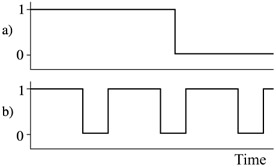
It is possible to present a graphic description of the behavior of the above-described system in different ways, the phase diagram being the most common.
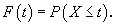
Let X be a random variable (r.v.) representing the lifetime of the system with F, its cumulative distribution function (c.d.f.):
If F is absolutely continuous, the...